Iceland Ring Road Itinerary 8 Days: The Ultimate Self-Drive Guide


Planning your first Iceland Ring Road trip and feeling slightly overwhelmed by where to start?
Wondering what’s actually worth seeing, how much you can realistically fit into 8 days, and what driving around Iceland is really like? (Plus the important question: where the hell do you find decent vegan food?)
I had exactly the same questions before James and I set off and, honestly, it ended up being one of my favourite trips we’ve ever done.
I’d wanted to visit Iceland for years. Ever since I watched The Secret Life of Walter Mitty and saw that iconic skateboard scene, if you’ve seen it you’ll know exactly the bit I mean!
No, I wasn’t about to bomb down a mountain on a skateboard (absolutely fucking not 😂), but it looked incredible. And somehow, Iceland still exceeded every expectation I had.
In the space of one day, we saw a thundering waterfall, a black sand beach and soaked in a hot spring at the foot of a volcano. Every time we turned a corner, there was something else that made us pull over and reach for the camera.
After driving the full Ring Road, we quickly worked out what was genuinely worth seeing, what we’d skip next time and, honestly, we were shocked at how much vegan food we found along the way.
So if you’re planning your own Iceland adventure, this 8 day itinerary is great for couples, and includes where to stay, hidden hot springs, glacier lagoons, our favourite food stops and the attractions we’d happily skip next time.
Iceland Route Map
Transport: Car or camper van (we used a camper)
Day 1: Reykjanes Peninsula & Reykjavík
If you can, try to book an early flight into Iceland.
Most campervan and car hire companies don’t open until around 9am, so the earlier you land, the sooner you can pick up your vehicle and actually start exploring.
Before you set off each day, it’s always worth checking road.is for road conditions, safe.is for travel alerts and vedur.is for the weather forecast. Icelandic conditions change fast, and roads can close with little warning, so I’d get into the habit of checking all three.
Reykjanes Peninsula
Reykjanes is right next to Keflavík Airport, which makes it the perfect first stop before heading into Reykjavík. And honestly? Don’t make the mistake we nearly did and just drive straight through.
Within about 30 minutes of leaving the airport, you’re already surrounded by black lava fields, steaming geothermal areas and dramatic coastal views.
One of the easiest stops to add in is the Bridge Between Continents, where you can stand on the North American and Eurasian tectonic plates. It’s actually pretty cool to think about the fact you’re literally standing on two continents.
When we visited in July 2023, the Litli-Hrútur eruption had just started, and visitors were actually being allowed to hike out to see it.
I found out a few days before we flew and genuinely lost my shit, I was so excited! We could not have timed that better if we’d tried.

⚠️ Heads up: There’s been ongoing volcanic activity in the Svartsengi area. Always check the latest updates from Visit Reykjanes and Safe Travel before you go.
Reykjavík
Reykjavík genuinely surprised me.
I went in expecting it to be a nice enough capital city, but I wasn’t expecting to love it as much as I did. In fact, I loved it so much that I came back with my mum after this trip, and luckily, she loved it too!
The first place most people head is Rainbow Street, which leads straight up to Hallgrímskirkja. It’s probably Reykjavík’s most famous view!
If you don’t mind heights, I’d definitely take the lift to the top of the church for views across the city. Just pick a dry day if you can. We didn’t, and I swear I have never been so cold in my life. The Icelandic wind is no joke.
If you’re vegan, Reykjavík is where you’ll be spoilt for choice. It’s pretty easy around the whole Ring Road, but it’s particularly easy here. There are loads of plant-based options, and even the American Bar had a daily vegan burger and beer deal.
Mum and I may have taken advantage of that offer more times than I’d like to admit 😂
And then, of course, there are the hot springs. Iceland is famous for them, and if you’re staying in Reykjavík, you’ve got two obvious choices: Blue Lagoon or Sky Lagoon.
I’ve now done both, and if you ask me which one I’d pick, it’s Sky Lagoon, every time.
It just felt a bit more special, with views out over the ocean, a more relaxed atmosphere, and honestly, I think it’s better value too. Blue Lagoon is iconic, and I’m not saying don’t go, but Sky Lagoon is the one I’d choose if I could only do one.
Where to Stay
Hotel: Exeter Hotel is a solid base in the city centre, well located for walking everywhere.
Campsite: Reykjavík Eco Campsite is your spot if you’re in a campervan. Central, well-facilitated, and actually pretty good for a city campsite.

Day 2: The Golden Circle & South Coast Waterfalls
On day 2 of this itinerary, you’ll leave Reykjavík to go and explore Reykjadalur Hot Spring and parts of the Golden Circle.
You’ll then head along the south coast to see some of Iceland’s most iconic waterfalls.
Reykjadalur Hot Spring
About 45 minutes from Reykjavík, Reykjadalur is a geothermal valley where you can actually bathe in a natural hot river, but there is a bit of effort involved.
The hike takes around an hour each way, so I’d definitely get an early start. Not only will you beat the crowds, but you’ll also give yourself plenty of time to fit it into your day.
The first 20 minutes are the hardest, with a fairly steep uphill climb, but after that the trail gets much easier. Along the way, you’ll pass steaming hillsides, bubbling mud pools, and even Djúpagilsfoss waterfall.
Then you’ll eventually reach the river, where you’ll find wooden changing screens dotted along the bank. The temperature changes depending on where you get in, so have a little wander until you find your perfect spot.
Just a warning though… the rocks are ridiculously slippery. I genuinely looked like Bambi on ice trying to get in!
And actually, we nearly didn’t make it here at all.
When we arrived, James fell out of the back of the campervan and badly hurt his ankle. I couldn’t drive at this point, so for a few minutes we were both quietly panicking that our entire Iceland road trip was about to fall apart.
Luckily, he was absolutely fine (eventually!), soldiered through the hike, and the warm water actually helped.
He did have a very impressive purple ankle for the rest of the trip though. Poor thing.
Tip: If you’re planning to snorkel between the tectonic plates at Þingvellir (which sounds incredible), I’d say to skip Reykjadalur. Doing both is going to eat up most of the day and you’ll end up missing other stops.

Geysir
This is where our original plans started to change.
We’d planned to continue on to Geysir and Gullfoss as part of our Golden Circle route, but after James injured his ankle at Reykjadalur, we were very behind schedule, so we had to skip them.
That said, both are stops I’d still recommend adding to your Iceland itinerary, and they were part of our original plan.
Geysir is one of Iceland’s most famous geothermal areas. The original Great Geysir is mostly dormant these days, but Strokkur has more than taken over the show, erupting every 5–10 minutes and sending water up to around 30 metres into the air.
It’s also a really easy stop to add in, with the geothermal area just a few minutes’ walk from the car park.
Gullfoss
Gullfoss is another classic Golden Circle stop, and for good reason.
The Hvítá River drops down two dramatic tiers into a rugged canyon, creating one of Iceland’s most impressive waterfalls. Even from photos it looks incredible, but like so many places in Iceland, it’s apparently somewhere that feels much bigger when you’re actually standing there.
There are several viewing platforms, so you can see the waterfall from a few different angles.
Seljalandsfoss & Gljúfrabúi
I could see Seljalandsfoss from miles away, long before we turned off the Ring Road, with water pouring straight down from the cliff face. And the thing that makes it so cool is that you can actually walk behind it.
The path from the car park takes only a couple of minutes, and it’s completely free to visit.
But prepare to get absolutely soaked.
My supposedly waterproof jacket gave up within minutes, and the path behind the falls gets seriously slippery. Take your time, watch your footing, and maybe just accept that dry feet are not happening today.
About a 10-minute walk further along is Gljúfrabúi, which feels like a bit of a hidden gem… even though it really isn’t a secret anymore.
This waterfall is tucked inside a cave, and getting there involves wading through a shallow stream and squeezing through a gap in the rocks.
My feet were completely soaked by the time I made it inside, but it was absolutely worth it.
Thank fuck we visited in summer, because I’m fairly convinced I’d have lost a toe to frostbite otherwise.

Skógafoss
Skógafoss is the final stop of the day, and honestly, it’s a pretty impressive way to end it.
The waterfall drops 60 metres over cliffs that were once Iceland’s coastline, and when the sun comes out, the constant spray creates a rainbow arching over the river.
There’s a staircase next to the falls that takes you up to a viewing platform, and it’s definitely worth doing if you have the time. But my favourite view was actually from the bottom, as you can fully see the falls.
If you’re into photography, this is a great spot too. Get your camera low and use the river as a leading line towards the waterfall, it’s a really pretty composition.
And if you’re visiting in summer, keep an eye out for the huge fields of lupins nearby. They make the perfect foreground with Skógafoss in the background and honestly look like something straight out of a postcard.
Where to Stay
Hotel: Hotel Skógafoss is the closest option and perfectly placed for an early start on Day 3.
Campsite: Skógar Campsite is right next to the falls, so you fall asleep to the sound of Skógafoss and wake up already there. This is what we did and it was a stunning spot.

Day 3: South Coast & Reynisfjara
Day 3 kicks off with a short hike to one of Iceland’s oldest swimming pools.
Next, you’ll explore one of the island’s lesser known waterfalls before heading towards Reynisfjara Black Sand Beach and the quaint town of Vik.
Seljavallalaug Swimming Pool
You’ll actually drive past the turnoff for Seljavallalaug on your way to Skógafoss, so you’ll start the day with a quick 10-minute backtrack up the road.
From the car park, it’s around a 25-minute walk into the valley, following a rocky river with moss-covered hills rising up around you. It’s a really beautiful little walk and honestly, the scenery on the way in is almost as good as the pool itself.
The only thing to know is that the path isn’t always obvious. Keep the river on your right, and you’re heading in the right direction.
Now, I have to be honest about Seljavallalaug…
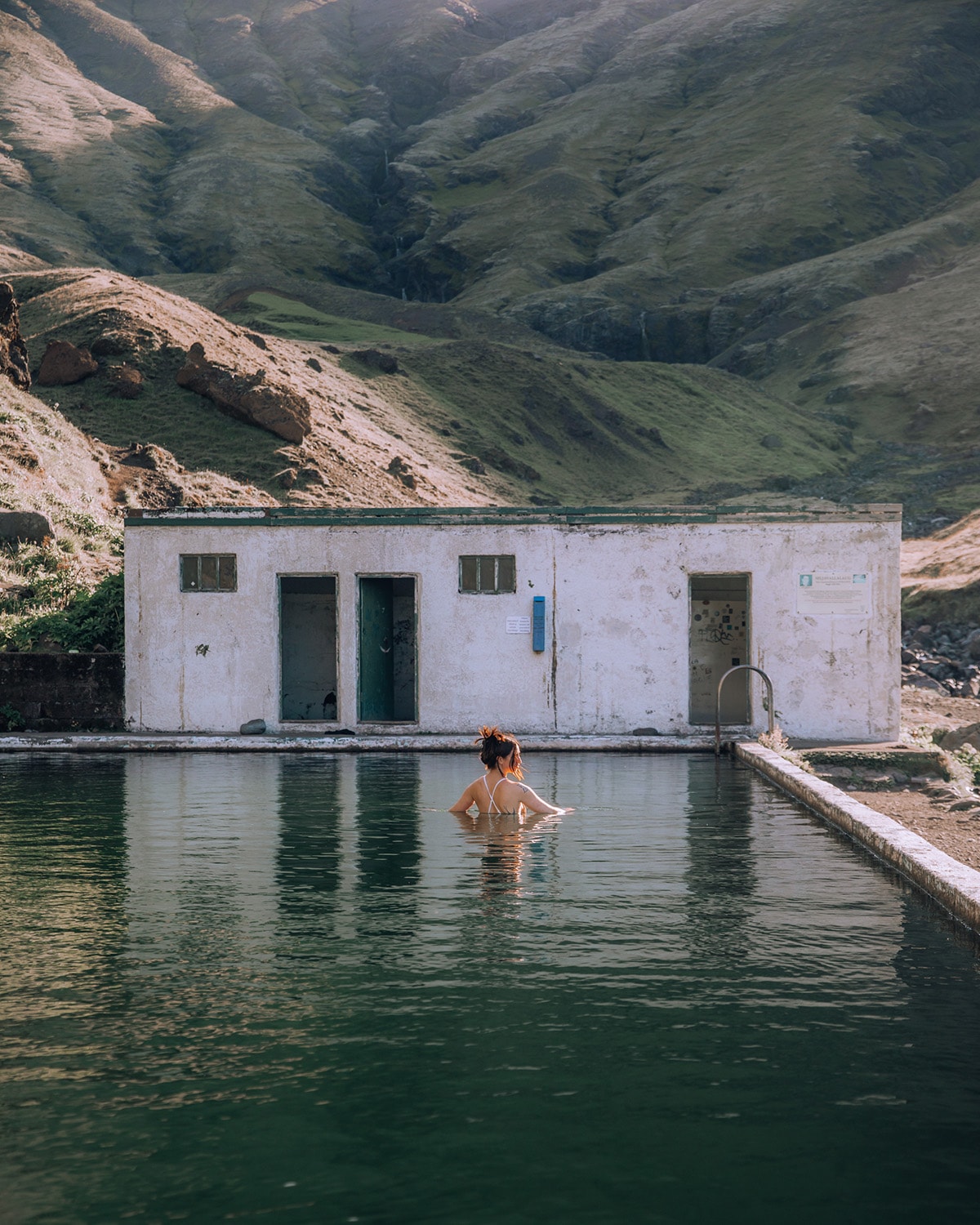
When we visited in July 2023, the water was full of green algae, which stained my white swimsuit (I was slightly annoyed because I only brought two with me), and the pool floor was so slimy that it definitely gave me the ick.
Don’t let the photos fool you. I might look happy, but I was dying inside!
That said, this is completely normal for natural pools in Iceland, and plenty of people won’t be bothered by it at all. If you’re someone who can happily jump into a wild swimming spot without overthinking it, you’ll probably love it.
If, however, the idea of algae between your toes makes you want to run away… consider yourself warned.
The changing rooms were also pretty run down when we visited, although recent reviews suggest they’ve had a bit of a refresh since then.
If you do make the walk, don’t just stop at the pool. Carry on further into the valley, and you’ll find a hidden canyon with a waterfall at the end.

Kvernufoss
Kvernufoss was probably the biggest surprise of our south coast trip.
It’s only a few minutes from Skógafoss, but while Skógafoss is one of Iceland’s most famous waterfalls, Kvernufoss still feels like a bit of a secret.
In fact, it was the quietest place we visited during our 8 days in Iceland. We didn’t see another person the entire time we were there (unless you count the sheep).
The waterfall is tucked away at the top of a canyon, and the walk from the car park takes around 15 minutes. It’s an easy little hike, and the best bit is that the path takes you around the back of the falls.
Looking back through the canyon you’ve just walked through, with the waterfall behind you, is such a cool perspective.
Honestly, if you’re looking for somewhere on the south coast where you can escape the crowds for a bit, I’d definitely add this one in.
Dyrhólaey Lighthouse
Around 30 minutes further along the coast is Dyrhólaey, a dramatic volcanic peninsula that was once an island before becoming connected to the mainland.
There are two car parks here, upper and lower, and they’re worth visiting because the views are completely different.
From the upper section, you’ll get views over Endless Beach, Dyrhólaey Lighthouse, and the famous Dyrhólaey Arch. The lower section gives you the classic view back towards Reynisfjara Black Sand Beach.
You can either drive between the two or walk. We walked because, well, we like getting our steps in. But just a heads up: the path is quite exposed, and the Icelandic wind can be brutal.
If you’re visiting in summer, this is also one of the best places to spot puffins. We visited in July and saw loads of them, so bring a telephoto lens if you have one.

Reynisfjara Black Sand Beach
Even though you can see Reynisfjara from Dyrhólaey, you can’t walk there directly, so you’ll need to loop back to the main road. It’s only around a 15-minute drive.
And honestly, this was one of the stops I was most excited about before our Iceland trip.
The black volcanic sand, towering basalt columns, and sea stacks rising out of the ocean actually make it look almost too dramatic to be real. Photos genuinely don’t do it justice.
Please be careful of the waves though. Reynisfjara is famous for its sneaker waves, which can appear suddenly and travel much further up the beach than you’d expect.
People have been seriously injured here, so stay well back from the water and don’t turn your back on the ocean.
One thing worth knowing is that erosion has changed parts of the beach in recent years, and access around the basalt columns can vary depending on conditions when you visit.
It’s still absolutely worth stopping, but it might look a little different from the photos you’ve seen online.

Vík
Vík ended up being my favourite overnight stop of the whole trip.
It’s the southernmost village on Iceland’s mainland, sitting beneath Katla volcano, with black sand beaches and dramatic cliffs right on the doorstep.
Perched on the hill above the village is Vík í Mýrdal church. The views over the village and the ocean are gorgeous, but if you’re visiting in summer, the real magic is the hillside covered in purple lupins. We went up at around 4am during the midnight sun and had the entire field to ourselves. (That’s one of the best parts about the midnight sun, you get places to yourself while everyone else is still asleep.)
I’m not exaggerating when I say I had the best coffee of our entire 8 days in Iceland here. Big claim, I know, but Skool Beans earns it. It’s an old American school bus turned café serving brilliant coffee, loads of vegan treats, and there’s even a resident cat wandering about. Honestly, what more could you want?
And the good food situation doesn’t stop there, either. Black Crust Pizzeria gave me one of the best vegan pizzas I’ve ever had, and even my non-vegan mum loved it, which is probably the strongest review I can give.
Where to Stay
Hotel: Hótel Kría is a cosy hotel right next to the Ring Road with an on-site restaurant and mountain views.
Campsite: Vík Camping is where we stayed. Good little campsite with shared facilities, though worth knowing the showers are open plan (girls with girls, boys with boys), so pack your swimsuit if you’re shy.

Day 4: Glaciers, Lagoons & Höfn
Today is one of the most scenic stretches of the Ring Road, with mossy canyons, huge glaciers, and iceberg filled lagoons all on the agenda.
Start early if you can. There’s a fair bit of driving involved, but you’ll want plenty of time to actually enjoy the stops along the way.
Fjaðrárgljúfur
I’m not even going to attempt to pronounce this one out loud, and I don’t feel too bad about it, because apparently plenty of Icelanders trip over it too.
Fjaðrárgljúfur flew pretty much under the radar until Justin Bieber filmed a music video here, and since then this dramatic canyon has become one of the busier stops on the south coast.
And honestly? I can see why.
The deep green walls, the winding river below, the sheer cliffs. It genuinely feels like something from another planet.
Give yourself around an hour to walk the out-and-back trail to the final viewpoint. It’s an easy one, but there are a few different viewpoints along the way, so don’t go charging straight to the end.
Svínafellsjökull
Part of the Skaftafell Nature Reserve, Svínafellsjökull is one of the many outlet glaciers spilling off Vatnajökull, the largest ice cap in Europe.
You can do guided glacier hikes here if that’s something you want to tick off your Iceland bucket list, but we gave it a miss.
We just didn’t fancy spending hundreds of pounds when you can walk right up to the glacier for free.
Instead, we spent about an hour walking the trail, which takes you right up close to the glacier tongue. If you stand still for a moment, you can hear the ice creaking and cracking away, which I thought sounded really eerie!
For me, that was more than enough though. I didn’t need to be standing on top of it to appreciate how incredible it was.

Svartifoss
Also known as the Black Falls, Svartifoss is one of Iceland’s most striking waterfalls, and that’s saying something considering how much competition it has.
The waterfall drops down a cliff face surrounded by dark basalt columns, similar to the ones you’ll see at Reynisfjara. The contrast between the black rock and the white water is what makes it so dramatic.
Getting there does require a bit more effort than some of Iceland’s roadside waterfalls. The walk takes around 40 minutes each way, but it’s a really beautiful trail through the Skaftafell area, and there are longer routes if you want to make more of a hike out of it.
Jökulsárlón Glacier Lagoon & Diamond Beach
Jökulsárlón Glacier Lagoon and Diamond Beach are two of Iceland’s most famous stops, and luckily they’re right across the road from each other.
Park up once, and you can easily visit both.
Jökulsárlón is a glacial lagoon filled with huge icebergs that have broken away from the Breiðamerkurjökull Glacier. They slowly drift across the water, changing shape as they go, before eventually making their way out into the Atlantic Ocean.
The colours are honestly incredible. Deep blues, bright whites, and sometimes even a bit of black volcanic ash trapped inside the ice.
We also spotted loads of seals popping their heads up between the icebergs, which was a cute little surprise.
I’ve actually been here twice now, once with James, and then again with my mum on a guided tour because after my first visit, it shot straight to the top of her Iceland bucket list.
On the second trip, we were lucky enough to see one of the icebergs crack apart while we were standing there. It sent a wave rolling across the lagoon, and the sound was so loud!
In summer, you can get out onto the water by boat or kayak if you want to get closer to the icebergs. But honestly, don’t feel like you have to spend extra money here. The views from the shore are already incredible.

Just across the road is Diamond Beach, where the ice from the lagoon eventually washes up onto the black volcanic sand.
This is where the name really makes sense. The chunks of ice look like giant diamonds scattered across the beach, especially when the sunlight catches them.
The size of the ice varies massively though, from tiny little shards to pieces taller than you are. When James and I visited, the ice was relatively small, but when I came back with my mum, the beach was covered in much larger chunks.
So there is a bit of luck involved and every visit can look completely different.
Höfn
The small fishing town of Höfn sits on Iceland’s south-east coast, with harbour views and glacier covered mountains behind it. It’s a good place to stop for the night, with plenty of accommodation and restaurant options.
We didn’t get much chance to explore as we’d already had a really long day by the time we arrived, so we just camped up at the Viking Guesthouse just outside town and called it a night.
Where to Stay
Hotel: Milk Factory is a converted dairy factory turned boutique hotel, right in the centre of Höfn with views over the harbour.
Campsite: Viking Cafe & Guesthouse is where we stayed. It’s a basic campsite but the bathrooms were really nice and even had sockets so I could straighten my hair!
Day 5: East Coast & Seyðisfjörður
Day 5 takes you along one of my favourite stretches of the Ring Road.
The east coast feels completely different from everything you’ve seen so far. Quieter roads, dramatic mountains, black sand beaches, waterfalls, and one of my favourite towns in Iceland (which is saying a lot!).
It’s also a bit of a slower-paced day, so take your time and enjoy the drive.

Stokksnes Black Beach
This black sand beach has rolling grass covered dunes, jagged mountains, and the famous Vestrahorn towering in the background. It’s a really dramatic landscape, and I’d been looking forward to photographing it since I first started planning our Iceland trip.
Unfortunately… Iceland had other ideas.
When we visited, Vestrahorn was completely hidden in fog. I’m not exaggerating when I say I could barely see my hand in front of my face. I was absolutely gutted!
We later found out the fog was linked to the Litli-Hrútur volcanic eruption, which is actually wild when you think about it. The eruption was happening on the Reykjanes Peninsula, right at the other end of the country, yet it was affecting conditions all the way over here.
Even though I didn’t get the Vestrahorn photos I’d dreamed of, Stokksnes was still a fun little stop.
Lækjavík
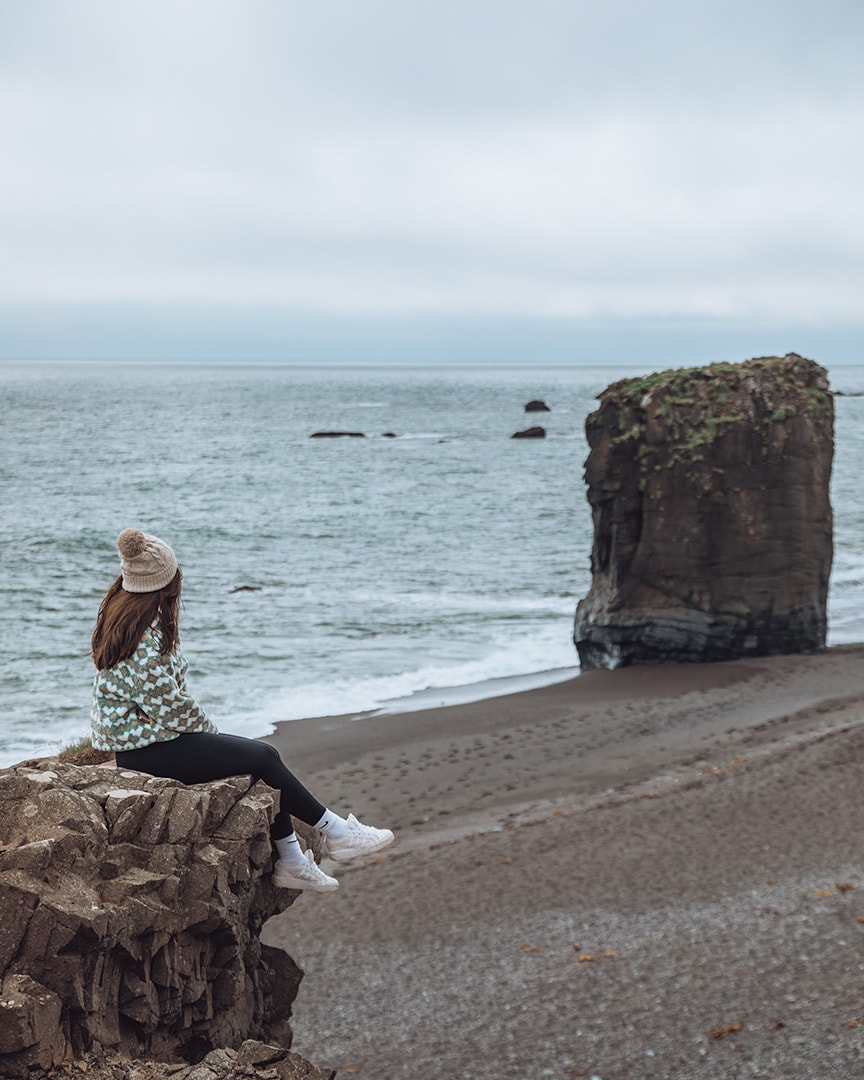
Lækjavík is a quick roadside stop along the Ring Road as you head east, with rugged cliffs, views out over the ocean, and a single rock formation sitting out in the water that makes for a pretty cool photo.
You can walk down to the beach, although just be aware that the waves here can be strong.
When we visited, the wind was absolutely freezing, so we grabbed a few photos and quickly legged it back to the campervan to turn the heater on!
Honestly, this is one I’d only stop at if you’re already driving past. It’s a nice little break to stretch your legs and grab some photos, but I personally wouldn’t make a special detour for it.
Folaldafoss
Folaldafoss is a much quieter waterfall tucked just off the Ring Road, and it’s somewhere most people probably drive straight past without even realising.
A short detour up Road 939 takes you to the parking area, and from there it’s only around a 10-minute walk to the falls.
It’s surrounded by rugged mountains, lush green landscapes and is a very quiet stop.
Seyðisfjörður
I absolutely loved Seyðisfjörður, and honestly, I could have stayed here much longer.
Tucked away at the end of a fjord, this colourful little town is easily one of the most picturesque places we visited in Iceland.
The drive down into town is beautiful too, and if you’re a fan of The Secret Life of Walter Mitty, you might recognise the road. This is where the famous skateboard scene was filmed, so obviously we had the soundtrack playing the entire way down.
The colourful wooden buildings were built by Norwegian merchants in the late 1800s and are some of the best preserved examples of their kind in Iceland.
The blue wooden church with the rainbow path leading up to it is the spot you’ve probably seen all over Instagram. And, because of that, you might have to wait a little while for your photo.
James and I were absolutely freezing while we waited, but our patience paid off.
Beyond the famous spots, I loved that Seyðisfjörður had such an artistic feel to it. There are colourful murals dotted around town, and we just loved having a wander.
Where to Stay
Hotel: Við Lónið Guesthouse is a sweet little guesthouse with stunning views of the fjord and surrounding mountains.
Camping: The campsite is really close to the centre of town and the rainbow path, with shared facilities including a kitchen and bathrooms with hot water.

Day 6: Stuðlagil Canyon, Dettifoss & Akureyri
Day 6 is a big one.
The northern stretch of the Ring Road feels completely different again, with geothermal landscapes, volcanic craters, lava fields, Europe’s most powerful waterfall, and a canyon that was hidden underwater until relatively recently.
There’s a lot packed into this day, so I’d start early and make the most of it.
Stuðlagil Canyon
I was so excited about this one when we were planning the trip.
For years, it was hidden beneath the waters of the Jökla River and wasn’t really accessible until the Kárahnjúkar Hydro Plant changed the water levels in 2009, revealing the incredible basalt columns and turquoise water below.
The basalt columns here are part of the same volcanic formation you’ll see at Reynisfjara Beach, created millions of years ago as lava cooled and cracked into those distinctive shapes.
Make sure you park at the correct car park on the east side of the river. There are a few different options, but this is the closest point to start the walk and saves you a lot of unnecessary extra distance.
The walk itself is fairly easy, mostly flat, and takes around 25 minutes each way. The scenery along the route is beautiful too.
You can climb down into the canyon, although the rocks are very slippery, so take care. Because James’ ankle was still bothering him after his campervan accident on day one, we decided not to risk it.
If you’d rather skip the walk altogether, there is a viewpoint car park on the opposite side of the river, which gives you a different perspective. We stopped there too, but personally, I think the views from the hike side are much better.
Despite being tucked away, Stuðlagil is no longer the hidden gem it once was. By the time we visited, it was already getting pretty popular.
We arrived before 7am and had the entire canyon completely to ourselves, which was incredible. On the walk back, we passed loads of other people heading in, so getting there early is absolutely worth it.

Dettifoss
Dettifoss is a waterfall where the word powerful genuinely isn’t an exaggeration. It’s officially the most powerful waterfall in Europe!
It’s a short detour off the Ring Road, but there is one thing to decide first: which side do you visit?
There are two options, the east and west sides, and they’re actually quite different.
The east side has the classic views, and you’ll generally get less spray, but the road in is gravel and much better suited to a 4×4.
The west side is the easier option, with a well-paved road and both upper and lower viewing platforms, making it a better choice if you’re driving a normal car.
Hverir
You’ll probably smell Hverir before you actually see it.
We had to close the windows in the campervan from about 10 minutes away because the sulphur smell is strong. Very strong. Like rotten eggs in your nostrils!
But if you can get past that, it’s a really cool place to explore.
Steam rises from the ground, bubbling mud pools are constantly boiling away, and the whole landscape is this unreal orange-brown colour that looks like you’ve landed on Mars.
There’s a well-marked trail through the geothermal area, so you can easily wander around without worrying about getting lost.
Just remember not to go wandering off the paths, the ground here is extremely hot in places.

Viti Lake
‘Viti’ translates to ‘hell’ in Icelandic, which is a pretty dramatic name for a lake… but I actually love the story behind it.
Apparently, the name comes from an old belief that hell lay beneath Iceland’s fiery volcanoes. I find stuff like this so interesting!
Viti sits at the top of Krafla, one of Iceland’s most active volcanic areas, and the bright blue water looks so pretty against the dark volcanic landscape surrounding it.
The car park is right by the crater edge, with only a short walk to see the lake.
Akureyri
I really enjoyed our afternoon in Akureyri. It’s such a sweet little town, even the traffic lights have red hearts instead of circles.
Like a lot of Iceland’s towns, it’s in a gorgeous setting, but there was just something about Akureyri that made me wish we’d planned an extra night here.
Before heading into the main part of town, we made a quick detour to Forest Lagoon, a hot spring perched on the edge of a cliff overlooking the fjord. The views over Akureyri and the water are amazing, and while we were soaking in the pools we actually spotted a whale flicking its tail out of the water.
I also nearly killed my drone here by flying it straight into a tree, which is probably why I still didn’t have my driving licence at that point.
Known as the Capital of the North, Akureyri has loads of great cafés, restaurants and bars, making it a lovely place to slow down for an evening after a busy few days driving.
If you’re running ahead of schedule anywhere on your Ring Road trip, I’d spend the extra time here rather than trying to squeeze in another stop.
Where to Stay
Hotel: Berjaya Iceland Hotels is just across the road from Akureyri Geothermal Swimming Pool, and their onsite bar has happy hour from 3pm to 6pm. Spicy marg anyone?
Campsite: Camping Hamrar is where we stayed. It’s a really cute campsite with a few little lakes dotted throughout and a nice view over the city.

Day 7: Whale Watching, Guðrúnarlaug & Stykkishólmur
I’ll be honest, this is the longest driving day of the whole Ring Road itinerary, and there aren’t loads of stops along the way. Today is really about making your way from the north of Iceland down to the Snæfellsnes Peninsula.
We just stocked up on snacks, stuck a playlist on and just enjoyed the drive.
Whale Watching in Akureyri
Before you leave Akureyri, it’s worth thinking about a whale watching tour.
Akureyri is one of the best places in Iceland to spot whales, and tours head out into Eyjafjörður where you have a good chance of seeing humpback whales, minke whales, white-beaked dolphins and harbour porpoises.
Most tours last between two and three hours, so factor that into your morning if it’s something you’d like to do.

Guðrúnarlaug
After a few hours of driving, Guðrúnarlaug is a lovely place to stop and stretch your legs. This reconstructed hot spring is named after Guðrún Ósvífursdóttir, one of the heroines from Iceland’s ancient sagas.
The original pool was destroyed by a landslide in the 17th century before being rebuilt in 2009.
We stopped here hoping for a quick soak, but when we arrived the pool was already full. I was gutted.
It’s actually much smaller than it looks in photos, and because it’s right next to a hotel, guests tend to pop in and out throughout the day.
I’d still stop if you want to break up the drive, but I probably wouldn’t go massively out of your way for it if you’d rather just get the big drive done.
Stykkishólmur
Stykkishólmur sits on the edge of Breiðafjörður Bay in the northern part of the Snæfellsnes Peninsula. It’s a beautiful little fishing town with Iceland’s signature colourful wooden buildings. It felt a little bit old worldy.
Unfortunately, when we stayed here, the smog from the volcanic eruption near Reykjavík meant we couldn’t properly see the surrounding mountains. Obviously this couldn’t be helped but I was a bit upset as I heard it was really stunning.
Even so, we really enjoyed wandering around in the evening.
Where to Stay
Hotel: Akkeri Guesthouse is right in Stykkishólmur, so you’re perfectly placed to have a wander around town in the evening.
Campsite: Stykkishólmur Tjaldsvæði is the town campsite and is where we stayed. It’s also in a good spot near the town.

Day 8: Snæfellsnes Peninsula & Reykjavík
It’s the last day of your 8 days in Iceland! The final stretch takes you around the Snæfellsnes Peninsula, which has glaciers, waterfalls, black sand beaches and dramatic coastlines.
Kirkjufell
On the way to Kirkjufell, you’ll drive over Kolgrafarfjörður Bridge, which is a really beautiful spot with mountains stretching out behind it. I got my drone up here, and it made for a really cool shot of the bridge winding over the water with the mountains in the background.
If you think you recognise Kirkjufell, you’re probably right. It’s one of Iceland’s most photographed mountains and appeared in Game of Thrones as Arrowhead Mountain (don’t worry, no White Walkers here).
Its unusual shape rises up behind Kirkjufellsfoss waterfall, and although it does get busy, we found a quiet spot by the river and chilled for a bit.

Svöðufoss
Svöðufoss surprised me, I genuinely don’t understand why it’s not more popular. It’s only a 30-minute hike from the car park, the waterfall pours down basalt columns, and it’s backed by Snæfellsjökull Glacier.
People are really missing a trick by skipping this one, but at least that means you won’t be fighting through crowds to see it.
Búðakirkja
The drive from Svöðufoss to Búðakirkja has some incredible views across Snæfellsjökull Glacier. I actually couldn’t believe how enormous it looked.
Búðakirkja is completely different from any other church you’ll have seen during your Iceland road trip. Painted black and sitting beside the Búðahraun lava field, it looks striking against the moss-covered landscape, or even more so if you’re visiting in winter with snow on the ground.
Most people stop for a quick photo before carrying on, but it’s worth walking past the church to the small golden-sand beach behind it as the coastline is beautiful.

Ytri-Tunga
Your final stop before driving back to Reykjavík is Ytri-Tunga, and because it’s literally just off the main road, there’s really no reason not to stop.
It’s one of the best places in Iceland to spot seals, with harbour seals and grey seals regularly chilling on the rocks. It’s only a short walk from the car park, just remember to keep your distance and let them do their thing.
From here, it’s around a two-hour drive back to Reykjavík to complete your Ring Road adventure.
Is 8 Days Enough in Iceland?
The short answer? Yes. Eight days is enough to drive the Ring Road and see Iceland’s biggest highlights without feeling like you’re constantly rushing from place to place.
That said, I could have happily stayed longer. Every time you turn a corner there’s another waterfall, black sand beach, glacier or mountain that has you saying, “holy shit.” It’s not a huge country, but there’s such an unbelievable amount packed into it.
After doing this trip, I completely understood why so many people spend two or even three weeks here, especially if you want to venture into the Highlands as well.
If you’ve only got five days, I’d focus on Iceland’s South Coast instead. You won’t make it all the way around the Ring Road, but you’ll still see some of the country’s most iconic landscapes without spending half your trip behind the wheel.

Best Time to Visit Iceland
Honestly? I don’t think there’s a bad time to visit Iceland. Every season offers something different, whether that’s puffins in summer, the Northern Lights in winter or colourful autumn landscapes.
That said, if you’re planning to drive the Ring Road, I’d recommend visiting between May and August. You’ll have the best chance of avoiding snow and road closures, plus the long daylight hours mean you can fit so much more into each day.
Outside of these months, the weather becomes much less predictable. Roads can close with very little warning due to snow or strong winds, which can completely throw your itinerary off. November to March is the trickiest time to attempt the full Ring Road (and I don’t really recommend it).
We visited in July because I desperately wanted to see the lupins in bloom and experience the midnight sun. We still had a couple of drizzly days, but overall I thought it was the perfect time for a road trip.
I also came back to Iceland with my mum in March, and it was noticeably colder. Personally, I wouldn’t have wanted to be driving the Ring Road then with the added risk of snow and ice, but Reykjavík and the South Coast still made a brilliant winter trip.
What to Pack for Iceland
Iceland’s weather changes ridiculously quickly, so it’s worth packing for all four seasons, even if you’re visiting in the middle of summer. I’d recommend bringing:
- A waterproof jacket and waterproof trousers
- Warm layers
- A hat and gloves, even in summer
- Sturdy waterproof hiking boots
- A swimsuit and quick-dry towel for the hot springs
- A reusable water bottle (the tap water is incredible!)
- A power bank for long driving days
- A camera or drone if you’re into photography
Even in July, I found myself wearing a jacket most days, so don’t assume summer means T-shirt weather.

Iceland Ring Road FAQs
Is 8 days enough to drive Iceland’s Ring Road?
Yes, 8 days is enough to drive the full Ring Road and see Iceland’s biggest highlights without constantly rushing, though you could easily stay longer if you have the time.
What’s the best time of year to drive the Ring Road?
May to August is best, you’ll have the best chance of avoiding snow and road closures, plus long daylight hours to fit more in.
Do you need a 4×4 to drive the Ring Road?
Not for the Ring Road itself, a normal car is fine.
Is Iceland’s Ring Road good for a couples or honeymoon trip?
Absolutely, it’s one of the most romantic road trips you can do. Driving it yourselves means you set the pace and get those quiet, early-morning moments (and jaw-dropping views) just the two of you.
Ready to Start Planning Your Iceland Trip?
This 8-day Iceland Ring Road itinerary is still one of my favourite road trips I’ve ever done. Whether you’re hiring a campervan or a rental car, it’s an incredible way to experience the country at your own pace.
It’s a brilliant trip to do as a couple, or even a honeymoon. We loved having the freedom to set our own pace, stop whenever we fancied, and make it feel like our own little adventure.
From waterfalls and glaciers to black sand beaches, geothermal hot springs and some of the cutest little towns I’ve ever visited, Iceland somehow manages to exceed every expectation.
If you’re hoping to keep costs down (because let’s be honest, Iceland isn’t exactly cheap!), I’ve put together a free guide to travelling Iceland on a budget, packed with the money-saving tips I wish I’d known before we went.
It covers everything from finding affordable food and avoiding unnecessary expenses, so you can spend more of your budget on the fun shit.