Travel Namibia 4×4: A First-Timer’s Honest Review


So you’ve decided you’re heading to Namibia and now comes the tricky part: finding a camper rental company you can actually trust. I get it. Before we booked anything, I spent days comparing companies, reading endless reviews, and sending so many emails I lost count.
I wanted to be 100% sure the camper would be reliable, safe, and set up for our three week road trip.
After a lot of research, we went with Travel Namibia 4×4 rentals, and I’m so glad we did. Their reviews and their replies to my (many) emails addressed every worry I had, from what happens if you get a flat in the middle of nowhere to how well equipped the vehicles are.
This Travel Namibia 4×4 review isn’t sponsored; I just had such a good experience that I wanted to share it for anyone planning their own self drive trip.
If you’re planning a Namibia self drive adventure, and trying to figure out whether this company’s worth booking, here’s everything you need to know from someone who’s been there, done it, and slept on the roof.
My Experience With Travel Namibia 4×4
I didn’t rush this decision. It was a long trip and a fair bit of money, so I wanted to make sure we booked with the right company.
Here’s how our experience with Travel Namibia 4×4 turned out.
What Made Us Choose Travel Namibia 4×4
So I think I actually must have emailed about ten different rental companies in my search for the perfect camper. I had so many questions about prices, what’s included, insurance and availability. You name it, I probably asked it!
Johan, who owns Travel Namibia 4×4, was by far the quickest to reply to me and was genuinely helpful from the start. His prices were really fair too! A lot of the other quotes I got came in slightly higher for the same dates, so that was an easy win for me already.
To save on some stress (and a few quid), airport or hotel transfers are also included, which meant one less thing to have to think about.
Plus, their cancellation policy was one of the fairest I found. It’s 25% if you cancel within 60–31 days, then gradually more as your dates get closer. Some of the other companies kept huge chunks months in advance, which just doesn’t sit right with me.
Of course, I checked the Google reviews too (who doesn’t?), and loads of people mentioned how quickly Johan and his team helped if anything went wrong, no matter how remote they were.
That was the bit that really sold it for me, as I was worried about breaking down in the middle of nowhere (might sound dramatic, but I definitely tend to catastrophise things in my head!).

The Booking Process
We booked our 4×4 rental in Namibia about six months in advance, choosing the Toyota Hilux 2024 model. Our quote came to roughly £2,600 for 22 days, including the tyre and windscreen waiver (insurance option 4) and a small cleaning fee.
That covered everything we needed for a fully equipped 4×4 camper! You can check current vehicles and rates here.
The booking process itself was a bit different from what I’m used to, but that seems to be the case with most things in Namibia! I usually book everything online through a website, but here, a lot of companies (including campsites) handle bookings over email and send payment links instead.
Johan emailed us an invoice with a 20% deposit payment link, which we paid without any issues. I’ll admit, it felt a bit strange at first, we’ve all been told not to click random links in emails, right? I hovered over it for a second, wondering if it was legit. But this really does seem to be the standard process in Namibia.
Just a quick heads-up: your card provider might charge a small foreign transaction fee. The remaining balance was paid when we picked up the camper.
👉 You can check out Travel Namibia 4×4 current availability on their website here 👈
Picking Up the 4×4 in Windhoek
If you’re picking up your camper straight from the airport, Johan will sort your transfer. We’d been travelling for about 20 hours, so we were absolutely f*cked, and decided to crash in a hotel for our first night. The next morning, Johan picked us up from our accommodation in Windhoek.
When we got to the office, the team walked us through everything, how to set up the roof tent, what was packed into the back, and even how to change a tyre (which I was really hoping we wouldn’t have to actually do, thankfully, we didn’t!).
Inside the 4×4 was absolutely spotless. There was some damage on the back bumper, but one of the guys pointed this out to us, so we were fully aware, and it was noted down.
The sleeping bags were fresh and clean, we even saw them hanging out to dry, which was really reassuring. I’ve had some very suspect smelling sleeping bags in the past, so I was happy to see this!
Some of the cooking bits were definitely well loved, but everything worked fine, so no complaints from me there.

The fuel tank was full on pickup and just needed to be full again on return, which is easy enough as there is a petrol station around the corner.
We sat down to go over the contract and a few safety bits like keeping your headlights on during the day, not driving after dark, and sticking to the speed limits. We also paid the balance here, and by the time we came back out, the guys had already loaded our bags into the camper which was really sweet.
We’d originally wanted a manual, but by the time we booked (around six months in advance), they were all gone, which shows how fast these things go. In the end, it probably worked out for the best.
The automatic was a dream on Namibia’s long, bumpy drives, and I was secretly relieved not to be worrying about gears the whole time. If you’re deciding between manual or automatic, I’d just go for automatic, the gravel roads make it a godsend.
What Was Included in Our Setup
This bit can honestly make or break your trip. There’s nothing worse than realising you’re missing half the essentials when you’re already hours from the nearest shop (I’ve been there before and it’s not fun!).
Inside the Car
We had a double cab, which meant there were two extra seats behind us, which was perfect for chucking all our bags in! James loves to tell me I overpack (and he’s not wrong, to be fair), so having the extra space was actually super helpful.
The car also had Bluetooth, so we could play music straight from our phones. It was a lifesaver on the seven hour drives when we’d either run out of things to talk about or were just too tired to make conversation.
And something I honestly didn’t realise I’d appreciate so much….cup holders! We bought so many coffees along the way, and having somewhere to actually put them made such a difference.

In The Back
Basically, all the camping gear you need to stay alive and self-sufficient for three weeks in Namibia. Here’s what came with our setup:
- Two large storage boxes packed with all the essentials: pots, pans, plates, bowls, cups, glasses, cutlery, and even a teapot.
- A braai (grill tray) – we didn’t end up using it as it’s mainly for meat and we’re vegan.
- A washing-up bowl. We bought a few tea towels ourselves to make drying up easier. This was the only thing we added to the setup.
- A fridge powered by a second battery that charged while we drove.
- A gas bottle with a cooking attachment (took a while to cook on, but did the job).
- A campsite power cable, really handy for places with electricity.
- A folding table and two camping chairs.
- A full tyre-changing kit, plus one spare in the back and another underneath the car.
- Jump leads, just in case.
- And still plenty of storage space left for our bags (and everything in them!), it’s surprisingly roomy back there!
The Rooftop Tent
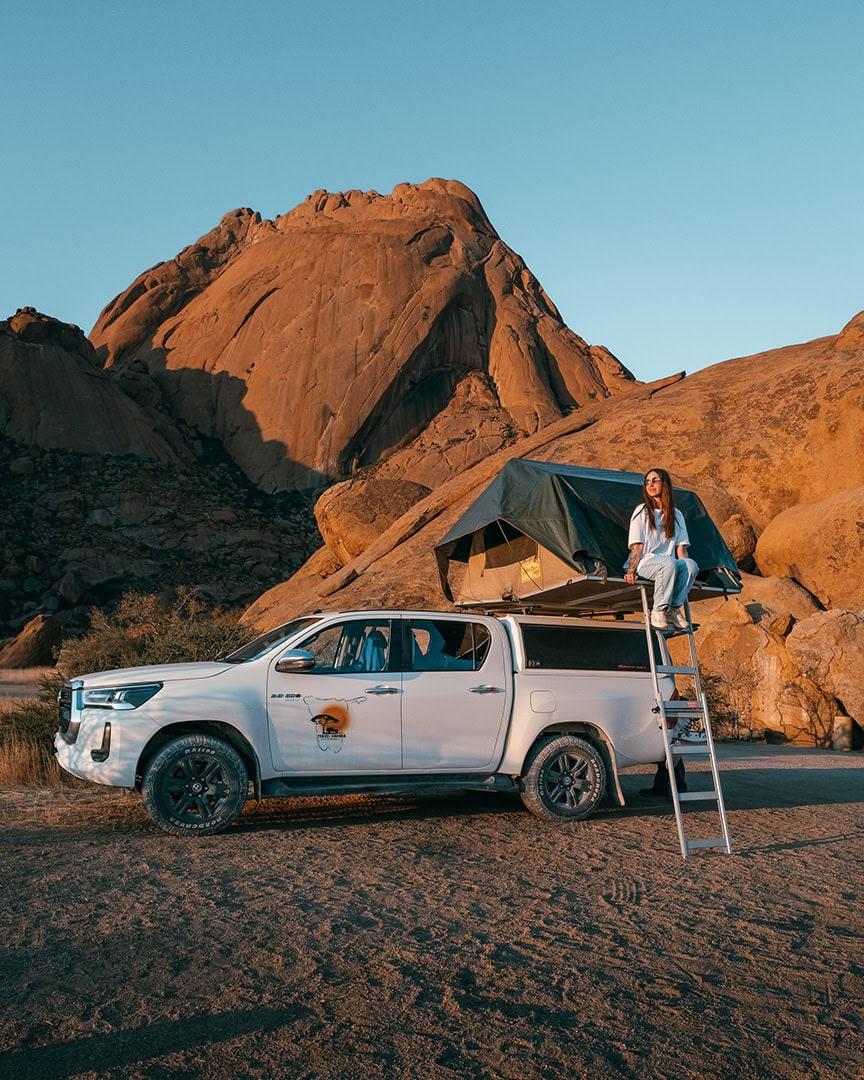
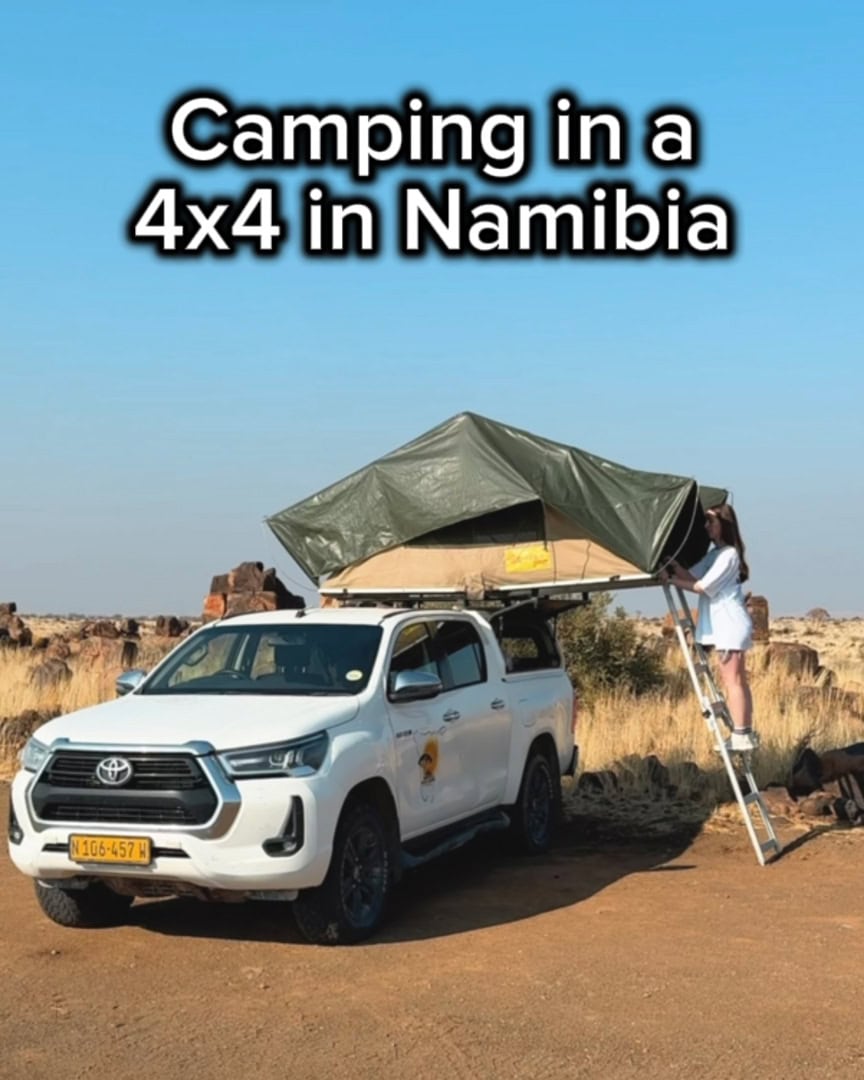
The rooftop tent folds down pretty flat and straps under a waterproof cover. When it’s time to set up, there’s a ladder attached to climb in. Inside, there’s:
- A comfy mattress covering the whole base of the tent
- Windows with mosquito nets, which you can zip up or leave open for airflow
- Two sleeping bags and a blanket (Johan even gave us an extra blanket to line the base for colder nights. It actually made a huge difference)
Honestly, they’d thought of almost everything. We didn’t have to buy or rent a single extra thing once we hit the road, apart from a couple of tea towels!
You can see how it all looked in my TikTok walkthrough below.
Driving the 4×4 (It Wasn’t as Scary as I Thought)
Like I mentioned earlier, we actually ended up with an automatic, and I’m so glad we did! I’d have been fine with gears, but having the automatic meant I could just focus on the roads (and trust me, there’s enough going on between the gravel, dust, and wildlife).
The 4×4 itself was massive compared to our little Toyota at home, so it took a few minutes to get used to, and my heart rate was through the roof for a moment!
James is definitely the more confident driver, so he took us out of Windhoek, and once we got to a nice straight stretch of tarmac, I jumped in and had a go.
It drove really smoothly, and the built-in reversing camera was so helpful! I’d never used one before but it was amazing!
Handling on Namibia’s Roads
Once we got to the gravel roads, I finally understood why everyone says to take it slow. The car handled them great, but you really do have to concentrate a lot when self driving!
The speed limit on most gravel roads is 80 km/h, but honestly, it’s all about judging the road that day. Some stretches were so rough we were crawling along at 20 km/h, and if you go too fast, the back wheels can skid out pretty suddenly.
The suspension was really good and soaked up a lot of the bumps, but the constant thudding gets really boring after a few hours!
We only had to switch to 4×4 a handful of times. Once on the road to Sesriem (I hated how bumpy and slippy it was there!) and again when driving over the sand at Sossusvlei to reach the Big Daddy and Deadvlei car park.
Just remember, you need to stop and shift into park before switching to 4×4, and once you’re in it, the absolute max speed is around 60 km/h.

Fuel & Range
Our camper came with two fuel tanks, one main and one backup, each holding 80 litres of diesel, so 160 litres in total. Even after our longest seven hour drive, we never actually dipped into the second tank (although I’m pretty sure we came close a couple of times!).
Filling up what was almost a full tank cost around £70, with diesel priced at about 19 NAD per litre when we were there.
We always made sure to top up before leaving a town or heading to the next stop, because petrol stations can be very few and far between, sometimes literally hundreds of kilometres apart. Better to be safe than stuck in the middle of the desert!
Setting Up The Rooftop Tent
I actually loved our roof tent. It was way more spacious than I expected. James is 6’4″ and even he had plenty of room to stretch out, so it’s definitely deceiving from the outside.
Here’s how the setup works:
- Park smart. Once you’ve found your spot, make sure you leave enough space to pull the roof tent out and extend the ladder. We learned this the hard way a few times when we parked too close to a tree, had to fold it all back up, move the car, and try again.
- Uncover and unfold. Take off the tent cover, unhook the ladder, and pull it down to unfold the tent. Make sure you’re on level ground since the ladder supports the tent’s weight.
- Add the poles. There are small metal poles that hook onto the awning to hold it away from the tent, which helps with airflow, especially on the hotter nights, depending on when you visit.
- Set up your bed. Climb up the ladder, roll out your sleeping bags and blankets, and you’re good to go. We clipped a small torch to one of the elastic loops inside so we had light at night, which worked perfectly.
- Pack down. When you’re done, fold up your bedding, unhook the poles, and lift the ladder to start folding the tent back in. James eventually mastered this on his own, but it’s much easier with two people, one folding and one tucking in the extra fabric.
- Cover it up. Once it’s folded, pull the waterproof cover back over and make sure it’s tight. If it’s loose, it’ll flap about while you drive.

Dropping Off The Camper
Handing the camper back was super easy. We didn’t have to set a strict return time, though you can drop it off anytime before 5 p.m. We just sent Johan a quick message when we were about an hour away to let him know.
Once we arrived, we parked up, unloaded our bags, and within a few minutes the team had us hopping into another car for a lift back to our accommodation for the night.
We’d literally just stepped out of the car at our apartment when Johan called to ask if anyone had left their phone in the camper, and that’s when the penny dropped. Of course, it was mine. Bless them, they drove us all the way back to pick it up (about 15 minutes each way!) and then dropped us off again. I’d love to say this is the first time I’ve done this!
That evening, we were in Windhoek without a vehicle, so we used Yango, which works just like Uber. It was super easy to use, cheap and saved us from having to figure out taxis or public transport.
The next day, we had our airport transfer included too, even though we’d already handed the camper back, which was such a nice extra.
👉 You can check Travel Namibia 4×4’s current availability here 👈
Would I Book with Travel Namibia 4×4 Again?
It’s probably no surprise when I say I’d 100% book with Travel Namibia 4×4 again for another road trip through Namibia. The only reason I wouldn’t is if I suddenly won the lottery and swapped the roof tent for luxury eco-lodges and infinity pools (a girl can dream right?).
The whole process was really easy from start to finish. The only thing that felt a bit different was booking everything over email rather than through an online platform, but that’s just how most things work in Namibia, including campsites, tours, even some accommodation. It did feel a bit old-school, but it didn’t cause any issues.
I maybe wouldn’t recommend this setup to anyone who doesn’t enjoy camping, but for us, it made this a trip of a lifetime. I also found the price we paid was really reasonable, especially considering it included transfers, tyre and windshield insurance.
If you’re thinking about planning your own Namibia road trip, it’s worth knowing what kind of budget to expect as costs can add up faster than you think once you factor in fuel, park fees, and campsite stays.